Superdetail Conversion – Trumpeter 1/350 Nimitz to Carl Vinson

Superdetailing the Carl Vinson in 1/350 scale

by Dave Kopielski

I started with the Nimitz model and converted it to the USS Carl Vinson CVN-70 as she was at the start of the 1983 world cruise (her maiden deployment).  All differences as well as the hangar bay details were scratch built. I purchased extra aircraft sets to fill ship with all 86 aircraft. The decals for the hangar bay and aircraft were made by me. The ship is also illuminated with over 500 feet of fiber optic lines and 40 LED’s.  Photoetch sets were used on the ship and for all the aircraft. The ship is also accented with resin CIWS and deck tractors, 3-D printed hangar doorways and Tilly Crash tractor.

A total of 777 hours were spent building.

Additional pictures can be found at the following locations.

On the IPMS-USA website – https://gallery.ipmsusa3.org/index.php?/category/davekop

On Facebook (build pics, no login required) – https://www.facebook.com/media/set/?set=a.10208964525897838.1073741834.1457024256&type=1&l=50e8812e52

On Flickr (high resolution images) – https://www.flickr.com/photos/128642409@N05/albums/72157687002588814

Posted in Kit Reviews | Leave a comment

Frankentanken

Frankentanken

by Ed Mate

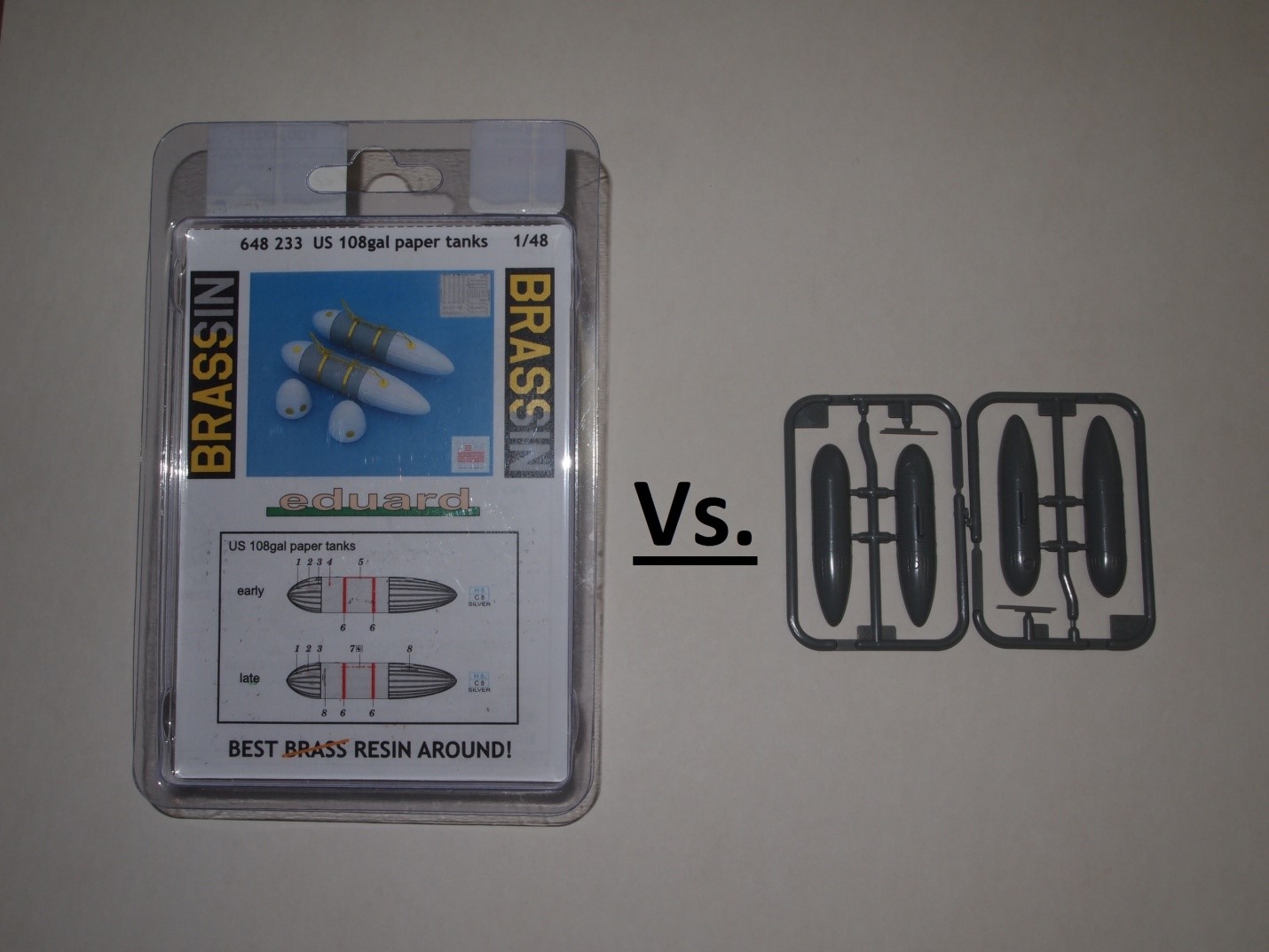
The 108 gal. paper tanks in the Tamiya 1/48 P-47D Thunderbolt kits are decent, but the modeler is challenged with cleaning up the seams on the nose and tail without destroying the fine raised detail. On many of my kits that last “rib” of fine detail is detached due to the difficulty of removing the parts from the mold. This is the reason I looked into the Eduard Brassin product.

However, working with the Brassin parts a number of other modeling challenges appear. The parts don’t attach to the model the same way so a mounting system must be created, multi-media – the straps and some details are made of metal and must be bonded to the resin, but by far the worst on this Brassin set is dealing with removal of the pour stub and clean up of the resulting mess.

Additionally, Eduard did not provide the “strap” at the transition from the cylinder to the nose and tail parts so an additional set of straps must be fabricated. I find it easier to work in plastic than in metal so I fixed up a tank using 0.005″ plastic strips:

The challenge with this approach is keeping the center straps parallel with each other and the front and rear strips while using near-instant drying super glue to bond the mixed media (plastic to resin).

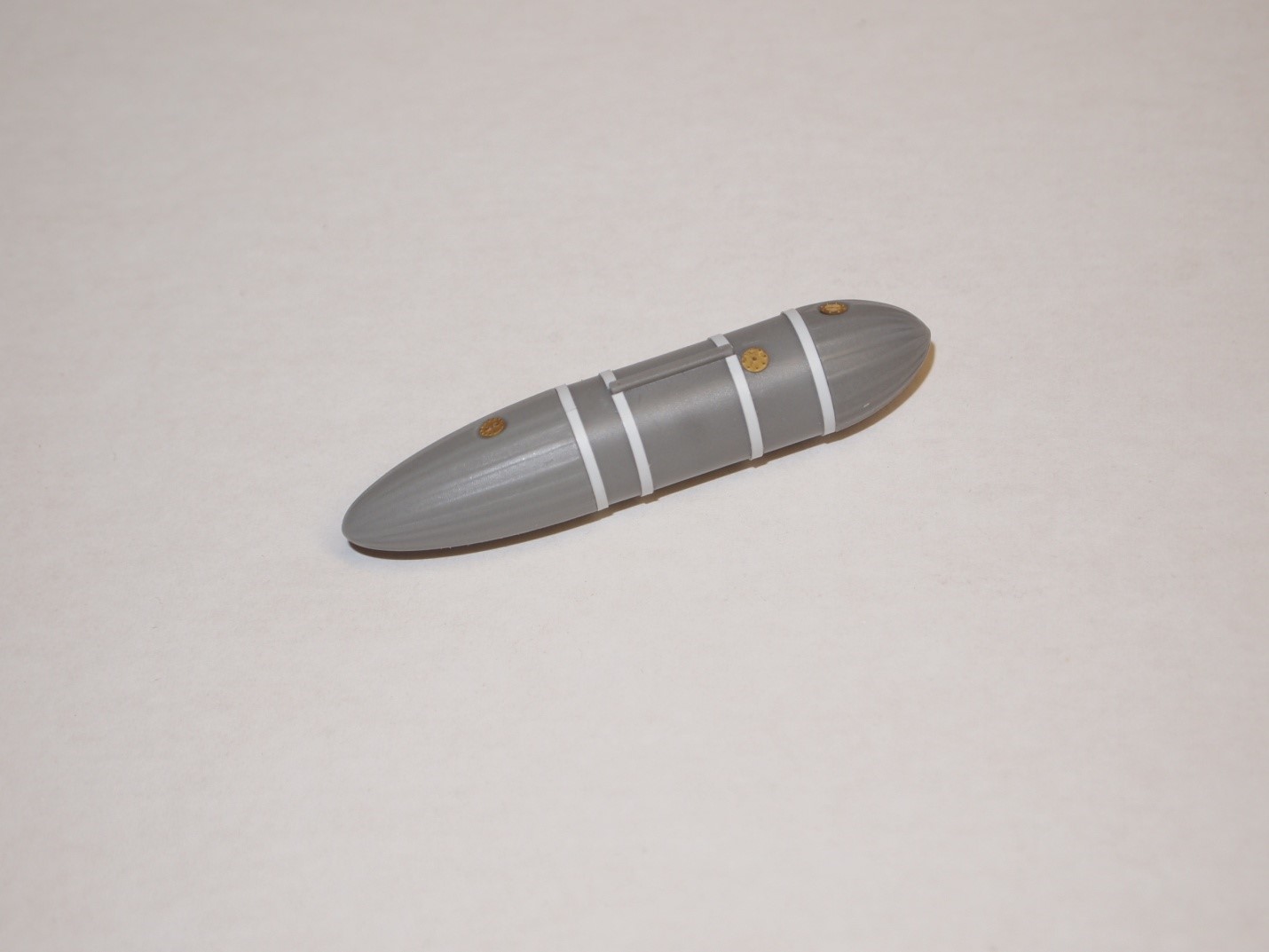
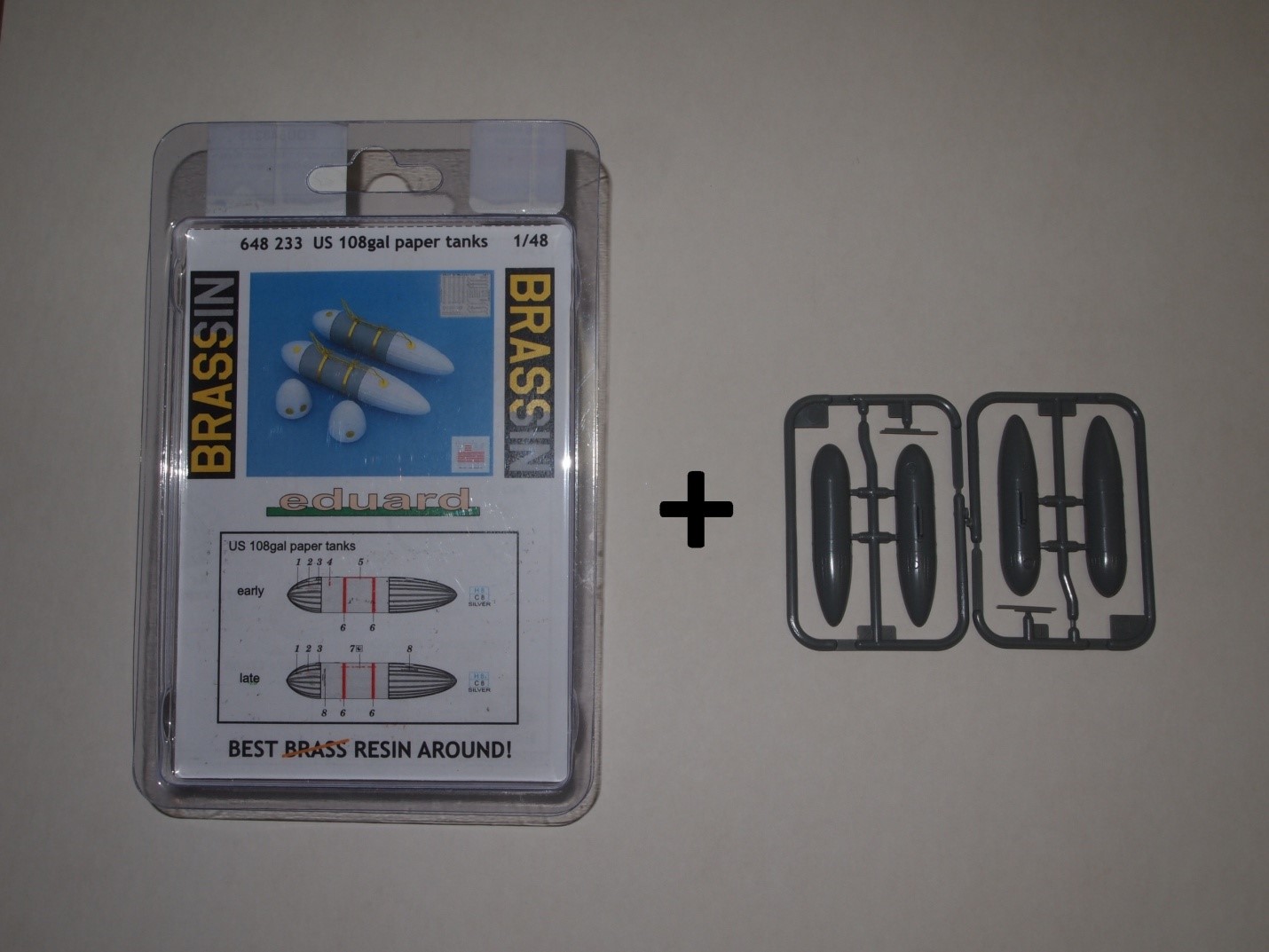
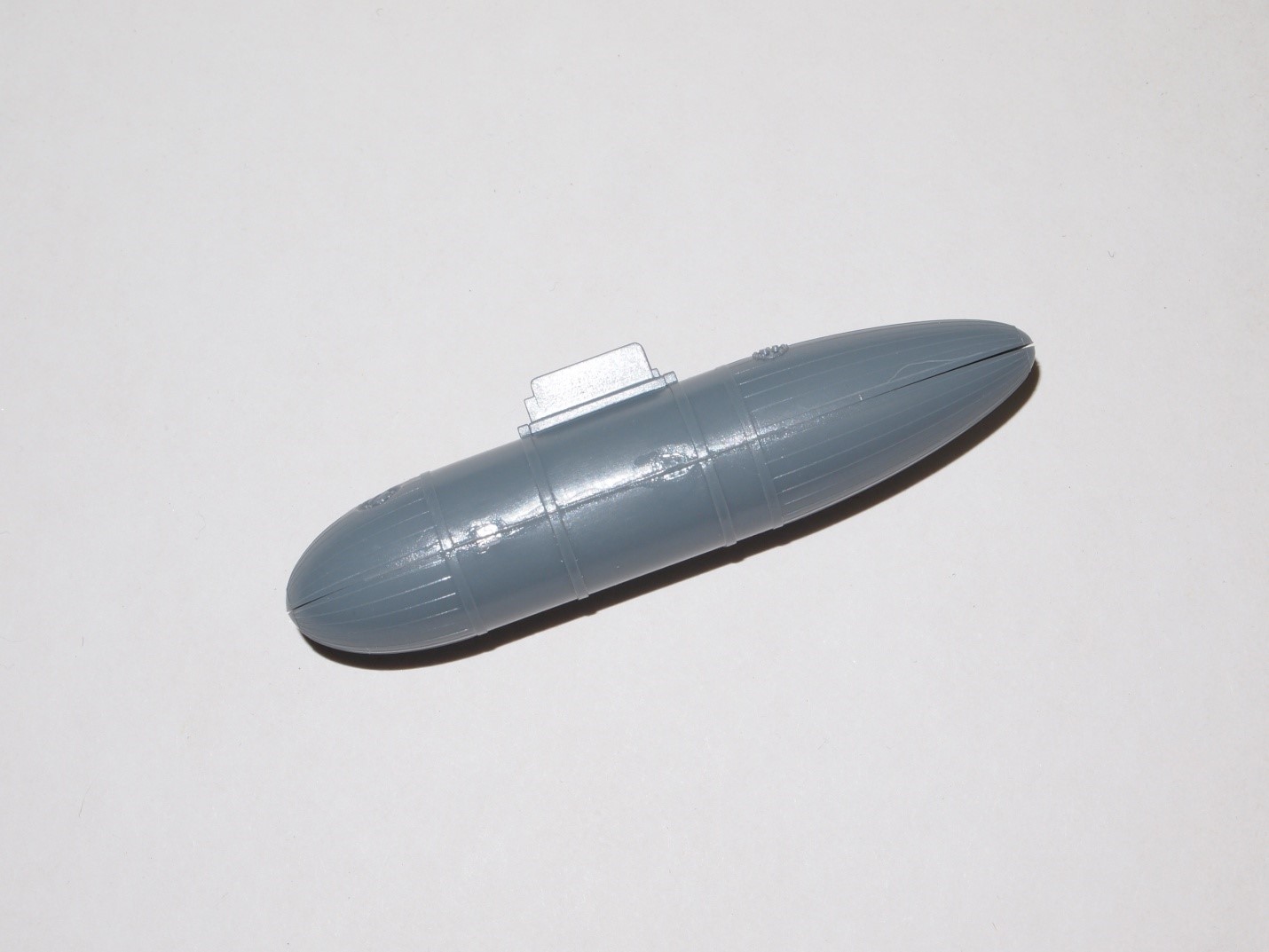
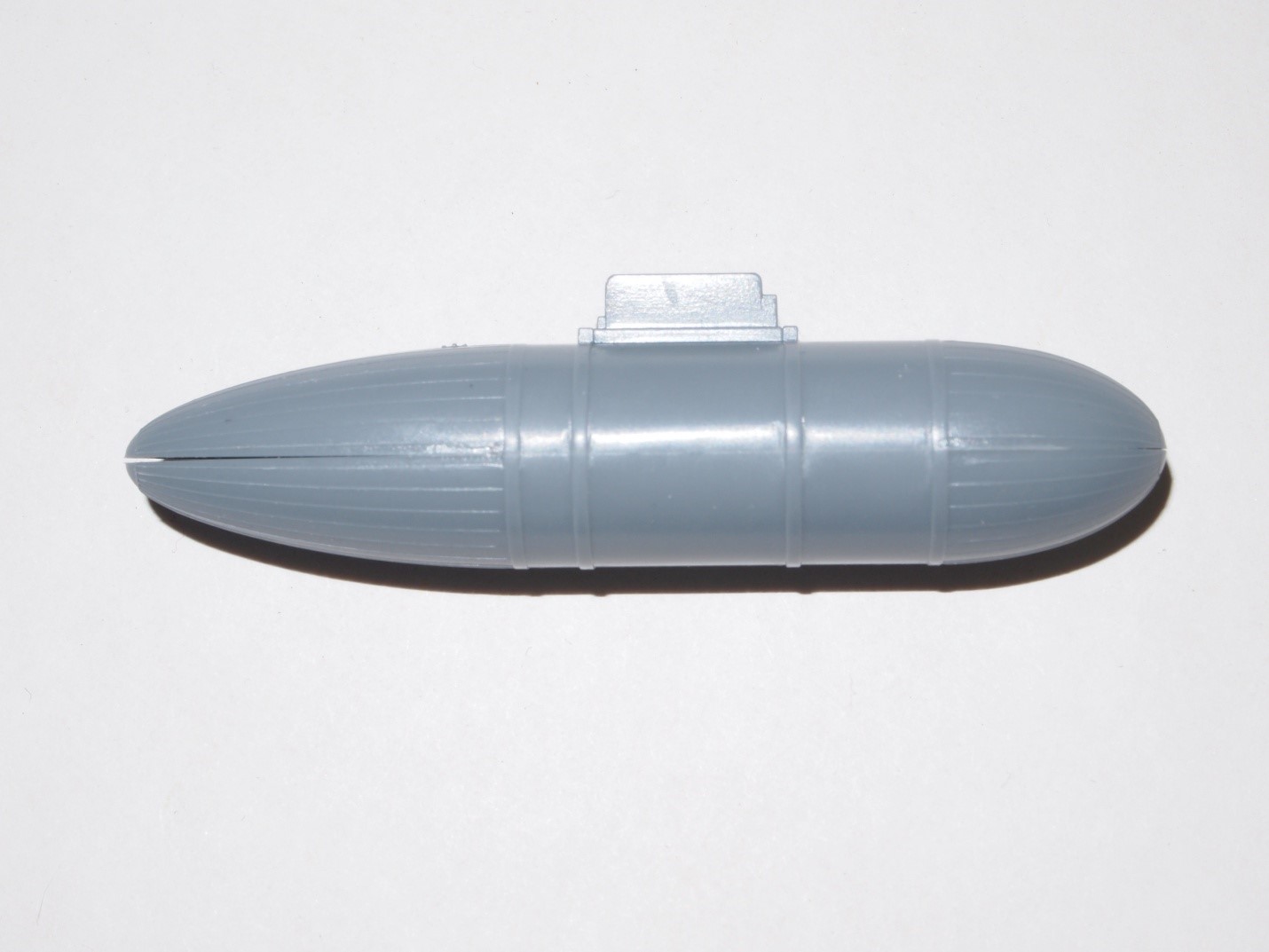
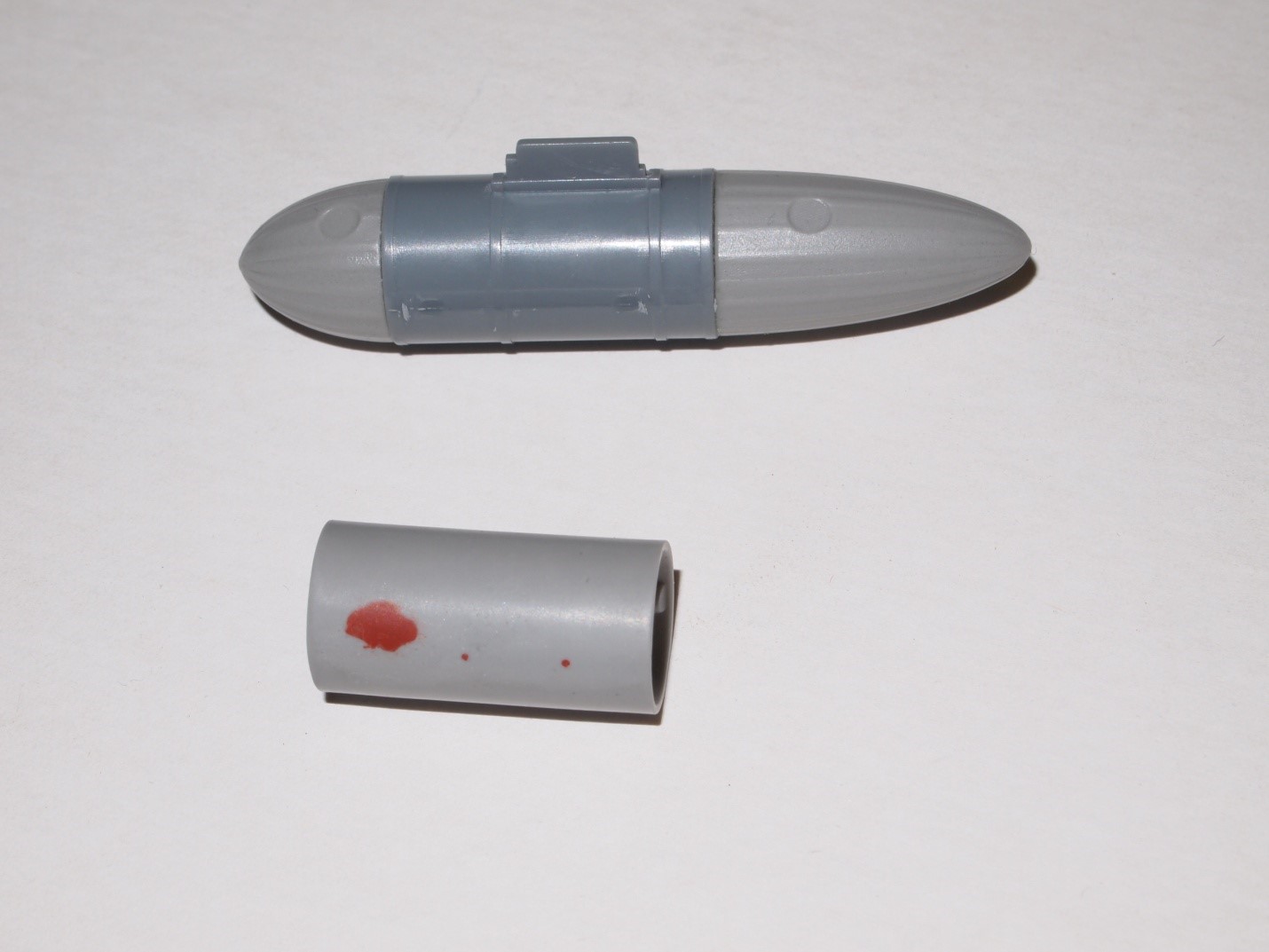
Looking for a solution to these issues led me to my current approach – the Frankentanken. This Frankenstein approach uses the kit parts for the cylinder and straps and the Brassin nose and tail parts with their nicely done rib detail.

The first step is to assemble the Tamiya kit parts paying close attention to the center cylinder to get the seam as good as possible with the straps aligned. No need to worry about closing the gaps at the nose and tail.

The next step is to clean up the seams like any seam work done on a plastic model. I like to use a Flexi-file with a sanding strip that has been thinned to easily fit between the closest straps near the tail. Then I polish out any scratches with fine grit sanding pads.

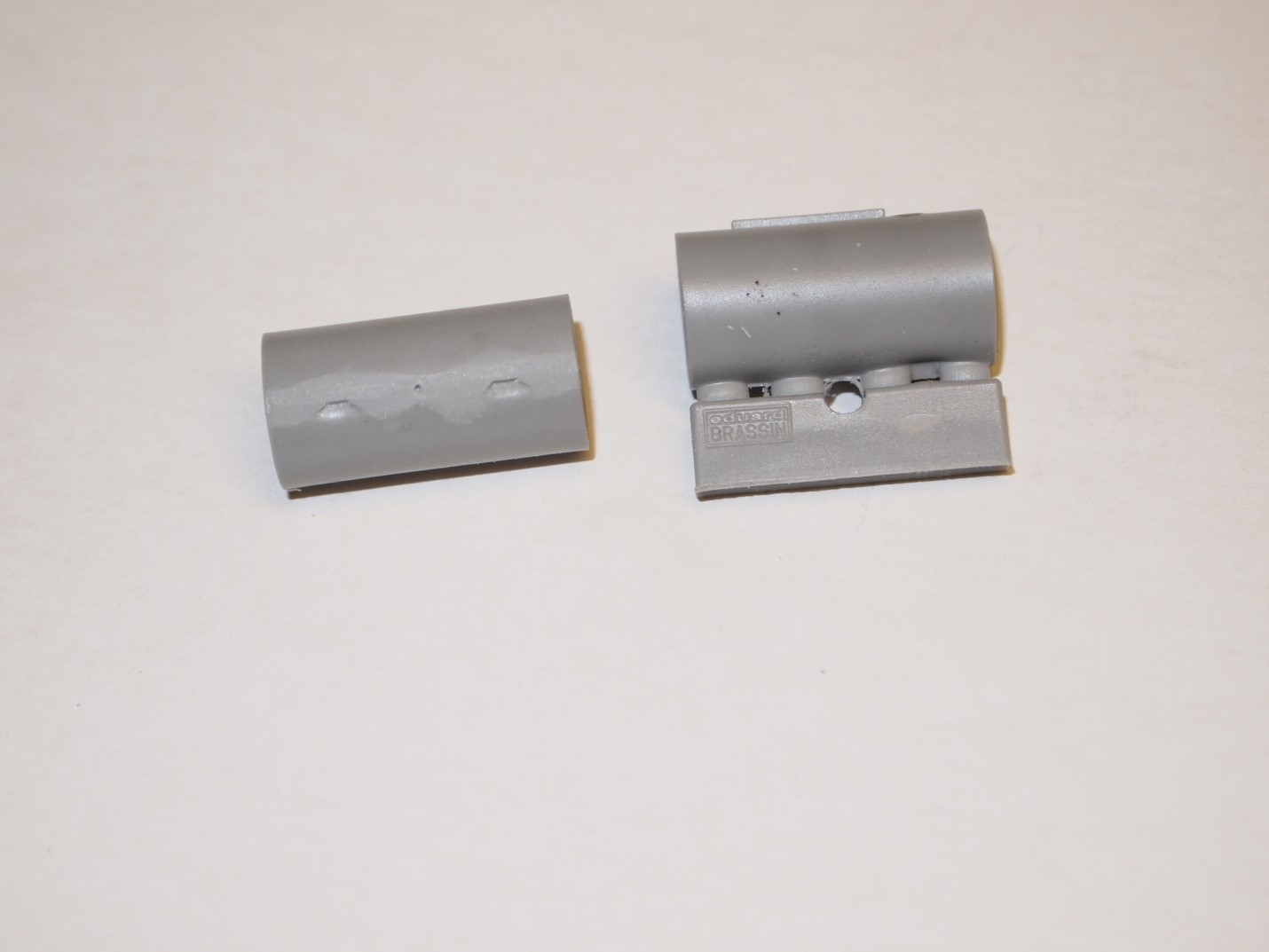
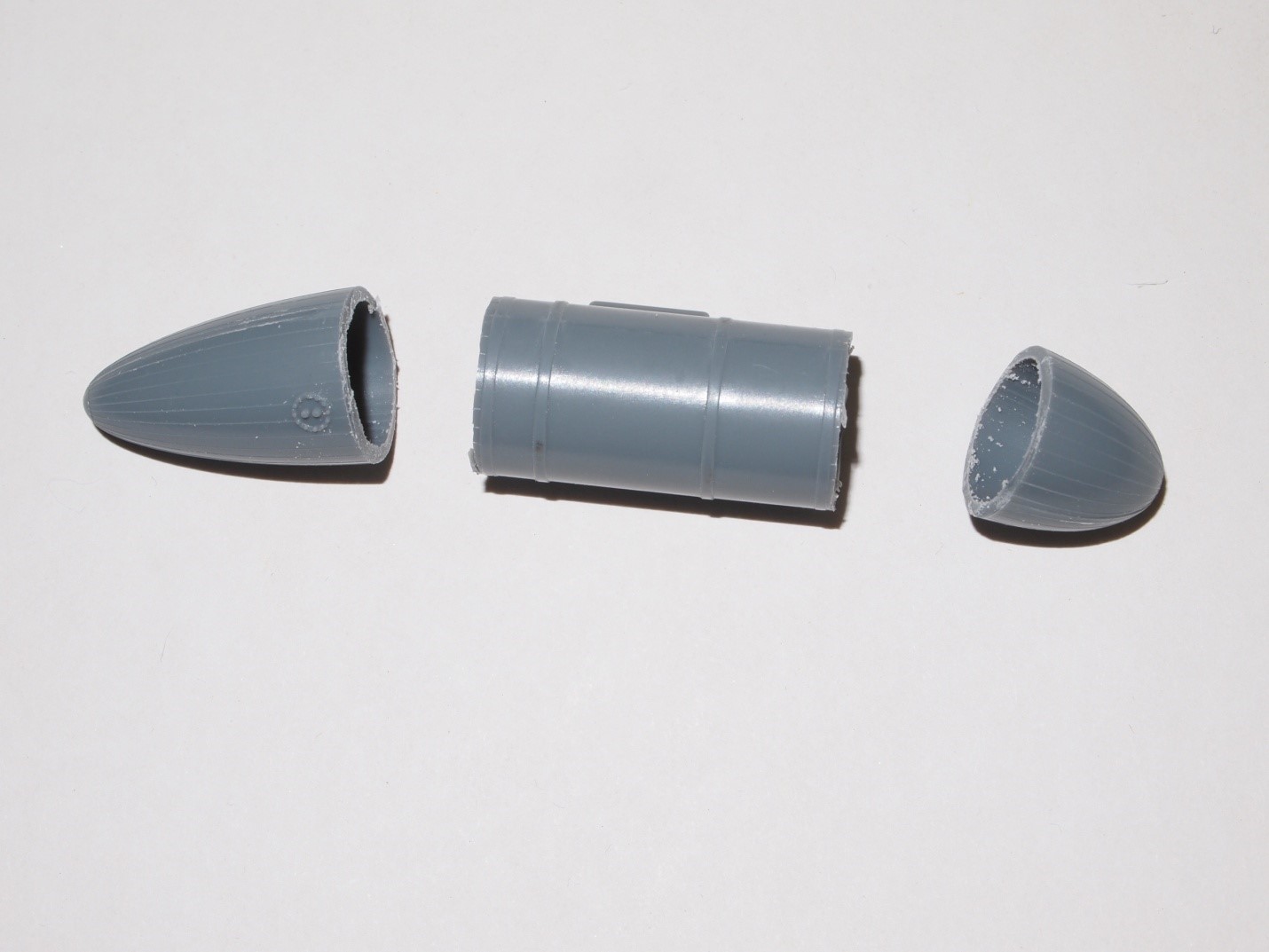
Now, cut off the nose and the tail. I use a razor saw and leave a little “waste” for final clean up ahead and behind the front and rear straps.

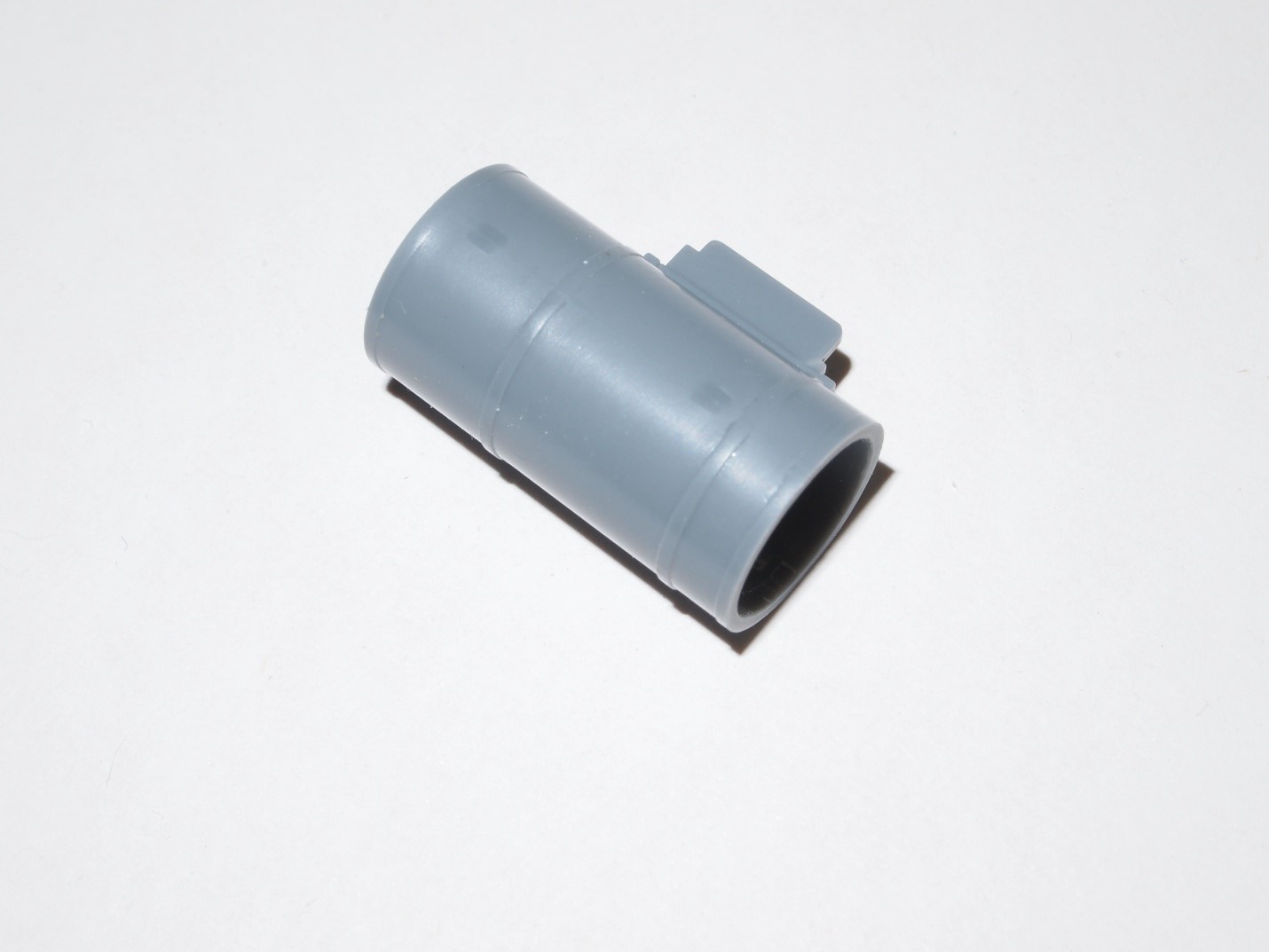
Now carefully trim the waste away and clean up the ends so they are nice and square. I use my lathe for this step but it can be done with a flat file – choose one that is wide enough to cover the full diameter. Also, I found that removing the alignment pin protrusions on the inside helps avoid any interference with the resin parts.

Now this is a very important step – do not neglect it! Drill a small diameter hole through the cylinder from outside to inside. I locate the hole in the mounting tab so it won’t be seen and won’t need clean up later. I discovered this the hard way. Epoxy cures with a thermal reaction that heats up the air trapped inside the cylinder. The expanding air ejects the part being bonded. So if you don’t want to hold the parts together for a seeming eternity, drill the hole to give the heated air a route to escape.

Next, attach the resin nose and tail with 5-minute epoxy. I do this in two sessions gluing first the tail then the nose. This approach takes the pressure off (no pun intended) in getting the parts aligned properly both axially and rotationally so the filler spots show up in the correct location relative to the mounting tab. I like 5-minute epoxy for this because it gives some time to align things and it will fill the small gap at the seam between the resin and plastic.

I’ve used the Brassin set photo etch filler cap and feed tube cover and I’ve salvaged the filler cap from the Tamiya part. Once those are in place, paint and attach to the model as you would have with the kit parts.

Posted in Kit Reviews, Tips and Techniques | Leave a comment

Marine Models USS Philadelphia 32 pounder Carronade

Marine Models USS Philadelphia 32 pounder Carronade

by Glenn Estry

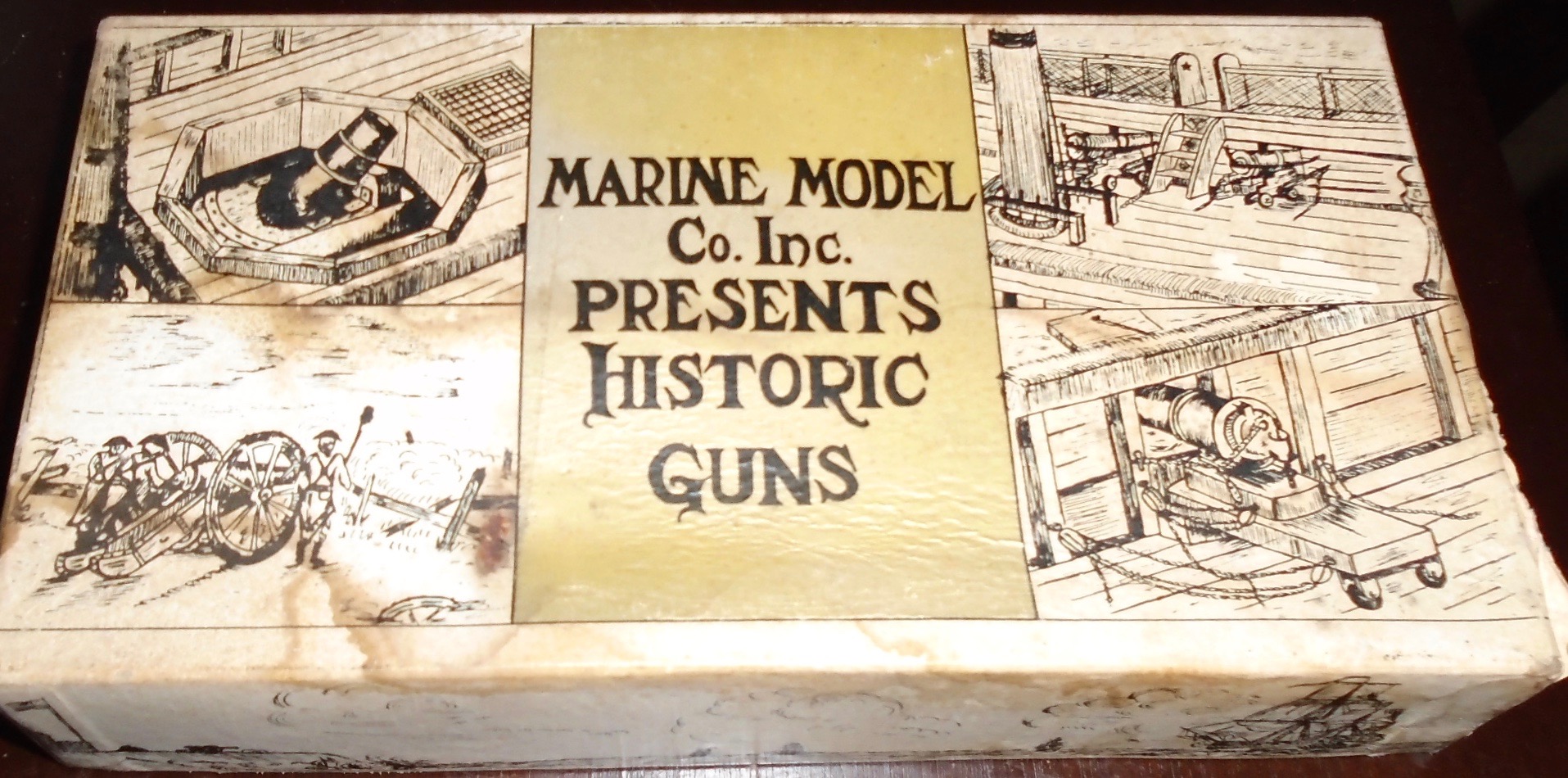
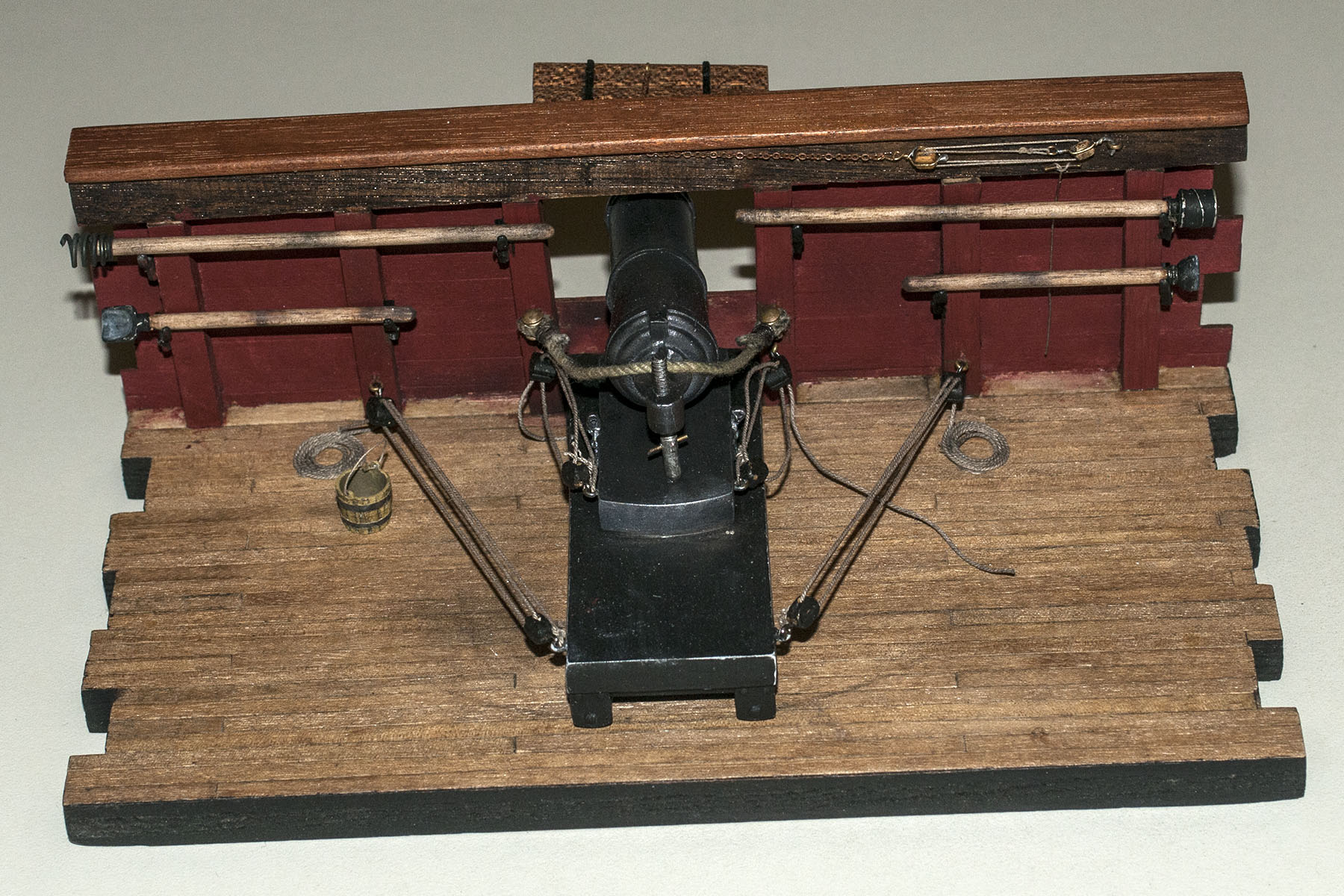
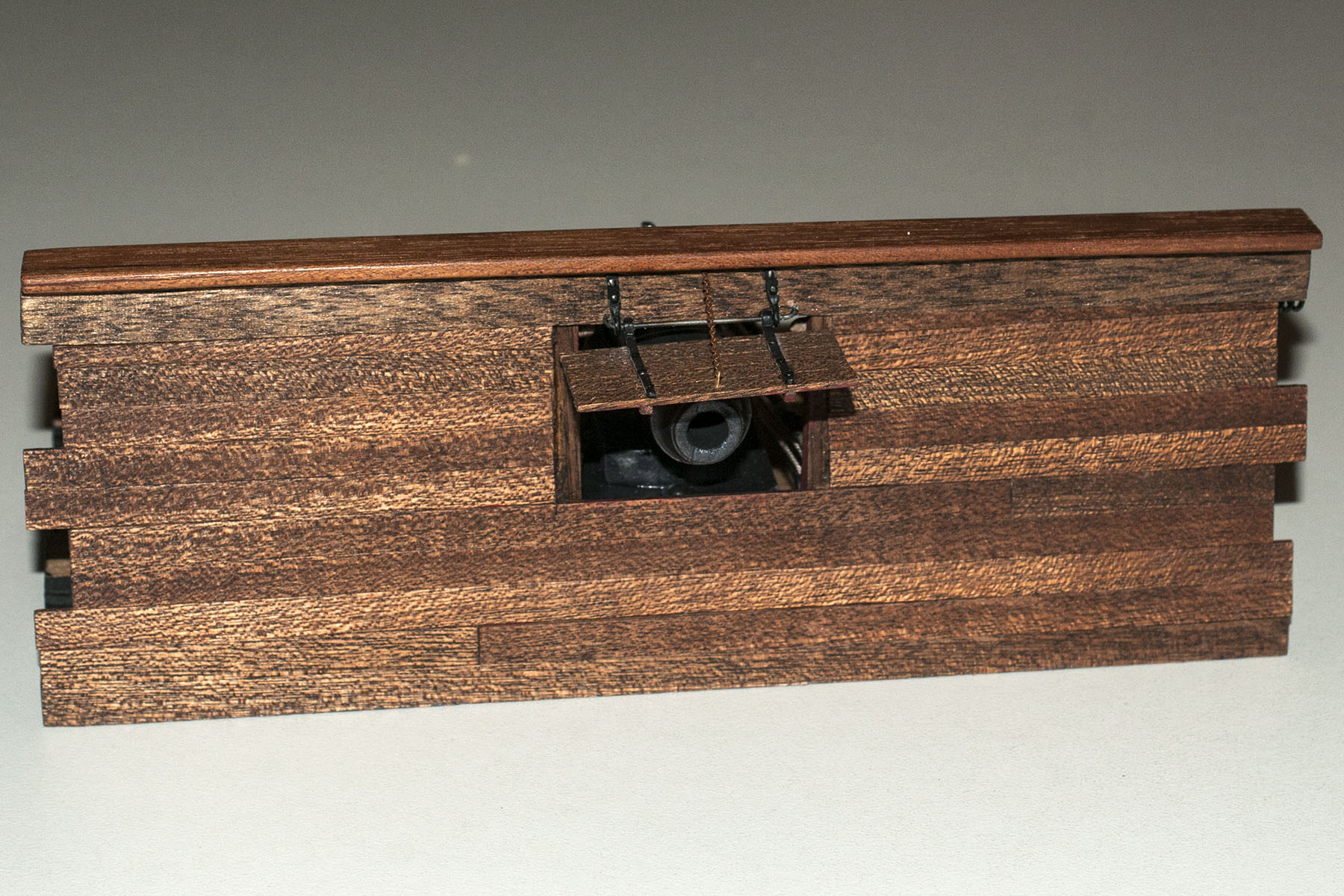
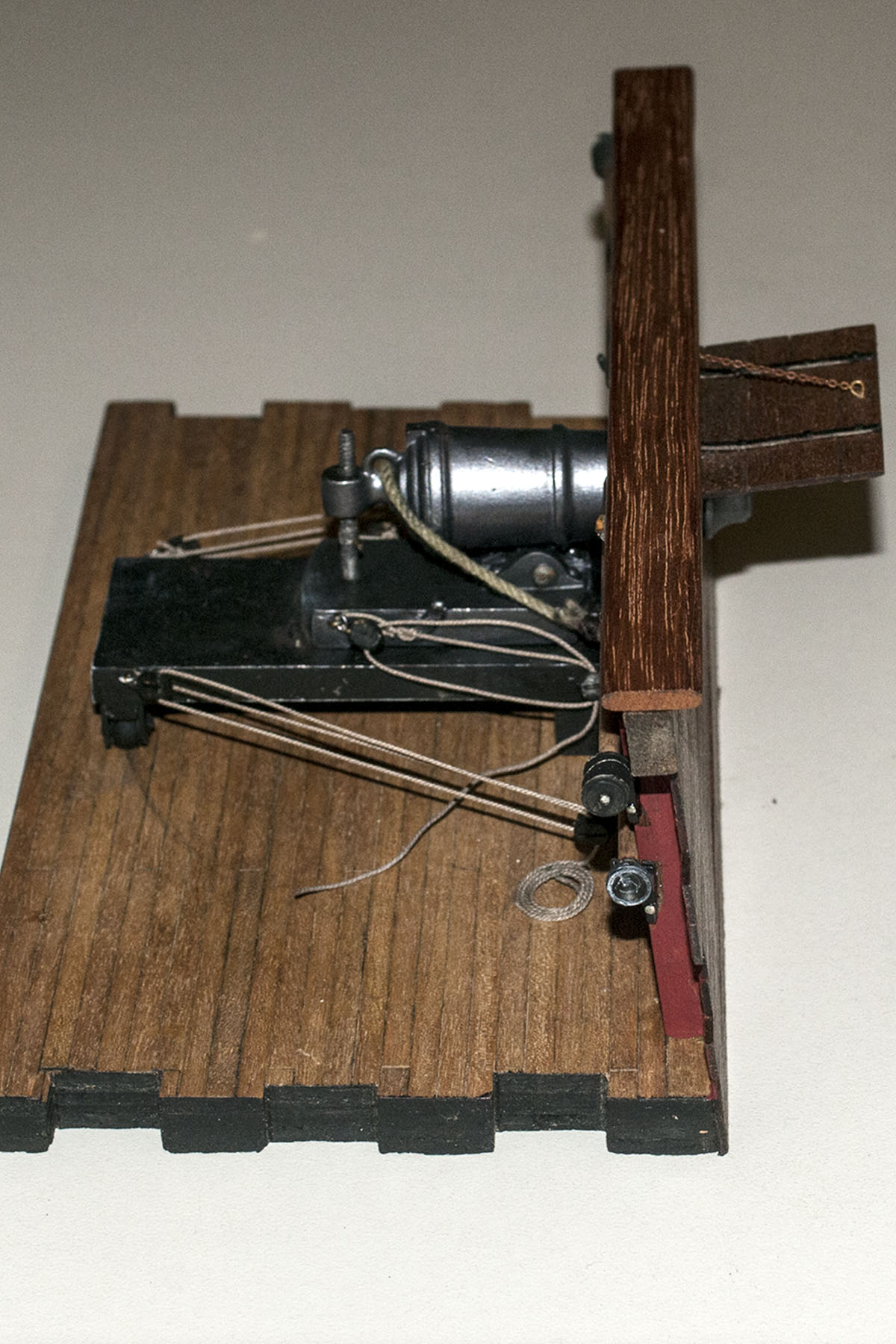
Marine Models USS Philadelphia 32 pounder Carronade. I won this kit (sight unseen) in an auction with a high bid of $20. The kit is from 1947, a 70 year old unassembled wood and cast metal kit. The base was a piece of plywood that the instructions said to draw lines to simulate deck planks. The bulwarks were were three pieces of mahogany which also were to have pencil lines to portray individual planks. Knowing that this would not produce a quality representation of a deck section, I raided my scrap wood collection and found 5/32″ x 1/32″ basswood and some 3/8″ x 1/16″ mahogany and scratch built the deck and bulwarks. Two of the 8 cast metal pieces used for hanging the tools were broken, so I made a RTV silicone mold of two intact pieces and made cast resin duplicates with dye added to the resin to make them match the others. The cannon and its platform were epoxied together and painted with Tamiya gunmetal from a rattle can. All other metal parts were painted flat black. The inside bulwarks were painted a dark red custom mix of Testor Acryl paints and the deck and bulwarks were stained using Minwax Golden Oak & Red Mahogany. The scale ropes are from Syren Ship Model Company. The handrail has no finish other than being sanded down with progressively finer sandpaper from 1,500 to 12,000 grit, giving it a nicely polished look and feel.

If you’d like, here is a brief history of what happened to the 2nd ship named USS Philadelphia (1799-1804).

During the First Barbary War Philadelphia cruised off Tripoli until October 31, 1803, while giving chase and firing upon a pirate ship she ran aground on an uncharted reef two miles off Tripoli Harbor. The Captain, William Bainbridge, tried to refloat her, first laying the sails back, and casting off three bow anchors and shifting the guns rear-ward. But a strong wind and rising waves drove her further aground. Next they dumped many of her cannons, barrels of water, and other heavy articles overboard in order to make her lighter but this too failed. They then sawed off the foremast in one last desperate attempt to lighten her. All of these attempts failed and Bainbridge, in order not to resupply the pirates, ordered holes drilled in the ship’s bottom, gunpowder dampened, sheets set afire and all other weapons thrown overboard before surrendering. Her officers and men were made slaves of the Pasha (or Bashaw).[6]

Philadelphia, which had been refloated by her captors, was too great a prize to be allowed to remain in the hands of the Tripolitanians, so a decision was made to recapture or destroy her. The U.S. had captured the Tripolitanian ketch Mastico, renamed her Intrepid, and re-rigged the ship with short masts and triangular sails to look like a local ship.

On February 16, 1804, under the cover of night and in the guise of a ship in distress that had lost all anchors in a storm and needed a place to tie up, Intrepid was sailed by a volunteer assaulting party of officers and men under Lieutenant Stephen Decatur, Jr. next to Philadelphia. The assault party boarded Philadelphia, and after making sure that she was not seaworthy, burned the ship where she lay in Tripoli Harbor. Lord Horatio Nelson, known as a man of action and bravery, is said to have called this “the most bold and daring act of the Age.”[7][8]

Her anchor was returned to the United States on April 7, 1871, when the Bashaw presented it to the captain of the visiting Guerriere.

Posted in Kit Reviews | Leave a comment

Meng P-51D Mustang in 1/48th Scale

Meng P-51D Mustang in 1/48th Scale

by Mike Hanlon

Since released in 1995, the Tamiya P-51D Mustang has been benchmark for 1/48 Mustangs kits.  A simple and rewarding kit, it is not without its flaws and before talking about Meng’s effort I would like to revisit the Tamiya kit.

Tamiya’s Mustang has been released in five different boxes and has had one update to correct a flaw in the kit.  In the original release, Tamiya molded the sprue gates directly to the clear parts, the result being that clear could not be removed from the sprue without being marred. The subsequent revision moved the gate to the edge of the windscreen and the canopy but care must still be taken when removing the part that can be easily damaged.  The main canopy is molded separately form the canopy frame and leaves a nasty seam if care is not taken in assembly.

The kit has some minor deficiencies; the interior is basic and not up to current day standards.  The propeller consists of four separate blades and a two-piece spinner that does not go together easily and is best replaced with a resin propeller from Ultracast.  The wheel wells are inaccurate as the main wing spar forms the rear of the well on the actual aircraft. The kit well has a rear wall that follows the curve of the well.   The remaining issue is that seam on the underside of the fuselage is difficult to clean up as it runs through the supercharger exhaust and some raised detail.  The wings are scribed and have reinforcing rivets over the wheel wells.  Mustang purists may want to sand and fill the scribed panels

None of these problems is insurmountable and the kit remains a pleasure to build. Since released I have built five.

Meng’s kit is billed as being “Fast Cement-Free Assembly”.  It contains well over a hundred parts as compared to the fifty plus parts in the Tamiya kit.  I had read Brett Green’s review on Hyperscale as well as his build in Military Illustrated Modeler.  Several of his concerns in building his model carried over to my build and may have added unneeded complication to my build.

First things first, you cannot build the model without glue, some parts would simply fall off and others would have unnecessarily large gaps.  Green indicates in his build that the tail wheel must be added before the fuselage is assembled, subsequent reviews from other magazines do not mention this.  He also states that if you modify the landing gear struts they can be installed after the wing has been assembled.  On my model I followed Green’s example and found the exposed tail wheel could be easily damaged.  I also assembled the wing with the landing gear installed and this complicated my build.  Subsequent reviews I have read do not mention adding the landing gear before assembling or there being any problem with adding them afterwards.  Inserts are provided for the machine guns in the leading edge of the wings.  They do not fit well and require filling.

I started my build with the interior and it is a marked improvement over the Tamiya kit’s interior.  The only issue is the instrument panel decal that is rather crude.  The instrument panel itself has only the outlines of the dials but no additional detail. One saving grace is that the panel is so deeply inset that it cannot easily be seen.  This is also true of the Tamiya kit.

Assembling the fuselage is quick with huge connectors but some force (I used pliers twice) is necessary to get the parts closed and in some areas the gaps required an application of Mister Surfacer.  The vertical stabilizer must be glued together and clamped or it also has a considerable gap. The curved upper fuselage piece requires that the antenna be added before it attached to the rest of the fuselage.  I stole an antenna from a junked Tamiya P-51 that I added after painting.

The flaps and ailerons are designed to be trapped between the upper and lower wings.  I cut off the forward part of the connectors so that I could install them after painting.  I did this because I was painting stripes on the wings which passed through both the flaps and the ailerons and I thought this was make painting them easier.  It did, but attaching them afterward was not as
simple as I had hoped, the remaining pins were fragile and easily broken.  I also question the angle of the dropped flaps as it is much steeper that the Tamiya kit.  As mentioned earlier the machine gun inserts are an extremely poor fit and require careful filling.  Like the Tamiya kit the wing panels are scribed and Meng adds counter-sunk rivet detail.

The kit does have some positive aspects; the drop tanks are designed so no sprue marks are visible and glue actually isn’t required for a good fit.  Meng offers cuffed Hamilton Standard and an uncuffed Aeroproduct’s propeller.  These were easily assembled after painting and a vast improvement over Tamiya’s props.

Both the original and the Dallas main canopies are included and require that the center-molding seam be sanded and polished out.  As of this writing there are no canopy masks for the Meng kit, but I found that Eduard’s mask for the Tamiya P-51D can used with a slight modification.  The windscreen required minor trimming to fit properly.

The kit provides a choice of two aircraft; a Fifteenth Air Force plane flown by Captain John Voll and a 9th Air Force bird flown by Captain Richard Turner.  I elected to use Aeromaster sheet 48226 Ninth and Fifteenth Air Force Fighter Aces.  Captain Freddie Ohr, the only Korean American ace in World War II, flew the plane.  The model was undercoated with Tamiya Gloss Black and painted with Alclad Aluminum and White Aluminum Lacquers.  The yellow tail and stripes were Tamiya Flat Yellow and Tamiya Flat Red was used for the spinner and nose.  I gave the finished model a wash with Flory water-soluble clay washes.

The finished model looks very nice and I am still unclear as to whether the problems I had were self-inflicted rather than the kit’s fault.  That being said, much of the engineering that went into making the kit “cement free” was wasted and a simple and more efficient build would have been possible if Meng had designed this as a conventional kit.

In summary, the Meng kit does have some advantages and I have a second kit that I will be building soon.  On the other hand, I’m not getting rid of my remaining Tamiya kits and of course Airfix and Eduard have new kits on the horizon.

Posted in Kit Reviews | Leave a comment