Revell F-84E Thunderjet, Kit # 85-5494 in 1/48th by Norris Graser


Revell F-84E Thunderjet
Kit# 85-5494 in 1/48

by Norris Graser

Revell F-84E 1/48th Scale

Revell F-84E 1/48th Scale

Revell has filled another hole in the early 50’s category of military aircraft with the release of their F-84E Thunderjet. This is an easy model to build, requiring you to spend more time painting and decaling than actually putting it together. As you will see, this is a versatile kit that allows you to build an early E or later vintage model. If you have the Revell F-84G kit, you can snatch the speed brake and use it as a late mod on the E or make an early G version, as they were produced with the E type brake.  Heck, you have both an etched metal and plastic speed brake in the G kit, which means you’ve got a spare!

There are only a few areas of concern on the model, principally the nose gear/wheel well,  a two piece affair which leaves a very difficult seam to fill and sand. This is the same problem found in the wheel well of the Tamiya F-84G,  prompting at least two aftermarket resin companies to offer up solid counterparts to replace kit parts.  Yes, a darn near perfect model!

The model features several  parts, specific to the F-84E, which are not found in the previous F-84G release, allowing you to make an early or late version  of the F-84E. These items include an altogether different  tail pipe and the earlier speed brake. Two different types of canopies are also included; one without framing (this was the original type, used through most of  the E series) and a later reinforced, framed canopy (made for the late Es and all Gs but retrofitted to most Es and many earlier marks).

F-84E Cockpit area

F-84E Cockpit area

Two external “fixes” were necessary so Revell could produce the two variants from common molds. The first involves the forward fuselage. The E had a smooth  forward fuselage but the G had a “suck in door” on either side. So you get two  rectangular shaped panels sans “suck in  doors” to make this an E. There is also an insert for the port wing near the wing root necessitated  by the fact that the G had a refueling receptacle in this position and the E did not.  

The only item Revell left out is the earlier type seat as  the one included in the kit came late in the E production and remained unchanged through the G. Again, seats were retrofitted to earlier built aircraft making it all but impossible to tell which seat was in use with any particular aircraft, unless you have a date for the markings you are going to use on your model.  

Other items found in this release, not included in  the F-84G version, include a pair of short takeoff RATO bottles and a pair of drop tanks.  All of the weapons found in the G are still here, except  the atom bomb, as this weapon was only first fitted to the G type Thunderjet

A nice feature common to both kits is the inclusion of flaps in both lowered and raised configurations. You will also find the wing tip refueling probes, but you will have to check references for individual  aircraft as they were removable items. As it turns out, neither aircraft featured on the rather large decal included in the kit had refueling probes in place. This based on research for each scheme.  (So eliminate them if you use the kit markings!)

F-84E left aft

F-84E left aft

A very useable decal sheet is included with plenty of stenciling and markings for two machines. The first is an early E ( F-84E-1-RE, 49-2097) with the non framed canopy in splashy markings worn by Col Carroll McColpin’s jet while he was CO of the 31st Fighter Group at Turner Field, circa 1949. I wonder if McColpin designed this scheme as he also was assigned a P-47 with a checkerboard design when he was CO of the 404th Fighter Group during WWII,. I only note it because checkerboards were not found on any other Thunderbolts in the 404th, just his!. 

The other squadron decal option represented is the 9th Fighter Bomb Squadron, 49th  Bomb Wing in Korea, 1952. 

Kit Construction Notes (This won’t take long)

I’m not going to go into any great detail here as the layout of the parts and the fit is very good.  I will state that I believe this F-84 ( and the earlier release of the G) goes together easier then the Tamiya kit, which preceded the first Revell release by some 6 months. The Tamiya kit  has a fit problem on the forward fuselage  gun access panel. This part is not a separate piece  on the Revell kit so, no problem, however both the Revell and Tamiya kit do share a common problem contained in the nose gear well; the way the parts are assembled leaves a seam that cannot be easily filled or sanded. I guess it’s only noticeable if you flip your model over and look for it, but it is there. It must be of concern to some modelers as no less then two resin manufacturers came out with solid resin pieces to replace the item in the Tamiya kit!!

there are a few areas of concern, though. I feel almost embarrassed to even mention this first because its a very minimal fit problem. But because you more then likely will be working with decals that have to follow  the contours of the forward fuselage, the last thing you need is to sand the hell out of the nose..  I had trouble getting the intake lip ring to fit flush against the assembled fuselage halves. Had I been paying attention, I would have test fit the piece another time or two as I’m certain it will fit with some sanding. 

Next up, there are two other assembly procedures that will require some attention.  The two fuselage inserts must be glued into place before the fuselage halves are cemented. The port wing root panel should also be added before the wings are assembled.  These are very precise fitting pieces, but if you don’t pay attention, you can easily misalign them, enough to be noticeable  under a metal finish paint job. My advice is to test fit these parts before gluing into place. The left side fuselage  insert (part 77) was a perfect fit, but the right side piece (part 76) needed a touch of sanding to drop into place. The port wing insert was also a good fit. I would advise gluing these pieces to place from the inside of the fuselage for the fuselage inserts and from the underside of the top wing for the wing insert. Use a liquid glue and  you can achieve uniform panel lines After gluing, a light sanding to make sure that the panels level with the surrounding area is advised. Remember though, these  parts are a concession by the manufacturer to do both the E and G types, so if you really want to go through the extra effort, feel free to ignore the above and fill & sand the panel lines on these components. 

The last item to address is necessary if you choose to use the rockets as your ordinance. The rockets are stacked and will require concentration, patience  and steady hands as there is not much of an area to  glue to. I spent more time aligning them but the result is worth it.  

I painted my Thunderjet using Floquil Old Silver and Bright Silver. For the landing gear I screwed around with the new Alclad II system. I haven’t experimented enough to comment on the Alclad, as I just kept it to the landing gear. I had no problems and the result looks ok.

A note about painting the wheel wells; everyone suggests the use of zinc chromate green, but as is the case of the predecessor to the Thunderjet (that would be the Thunderbolt, of course) use Yellow chromate. I met a man who worked at Republic and he told me they had a LOT of yellow primer and were too cheap to toss it out to go with Chromate Green specs. That’s as good a reason as any to explain why everyone else used green except Republic!

Do I recommend this model? You bet.

F-84E port rear

F-84E port rear

F-84E starboard front

F-84E starboard front

Posted in Kit Reviews | Leave a comment

Phreakin’ Phantom – Hasegawa’s F4-E in 1/48 by Mike Hanlon

Phreakin’ Phantom
Hasegawa’s F-4E in 1/48

by Mike Hanlon

Hasegawa F-4E - 1/48 Scale

Hasegawa F-4E – 1/48 Scale

Introduced into Navy service in the late 1950’s, the F-4 series gave the Navy a fighter that met or exceeded contemporary Air Force designs for the first time. So successful was the design that it was adopted for service with the Air Force first as the F-4C and then the F-4D.   Originally designed as a fleet interceptor, the Navy planners saw no need for cannon, relying instead on a battery of radar guided Sparrow missiles with Sidewinder heat seeking missiles serving as the close in weapon of choice.   Air Force planners in the late 50’s also concluded that cannon were redundant and totally unnecessary in a modern fighter. Service in Vietnam facing Mig 17 and Mig 21 fighters caused the planners to change their minds. First flown in 1967, the F-4E incorporated a 20mm Vulcan gattling gun.

In 1979, Hasegawa released their first 1/48 scale modern jet, the F-4J. Featuring raised panel lines, a full missile load and detailed cockpit; the kit was released for the wallet-crunching price of $20.   Despite howls of rage from frugal modelers everywhere, the kit was quickly followed by an F-4B/N and an F-4C/D. Several years later, (1983?) Hasegawa released the F-4E. This was a newly tooled kit featuring scribed panel lines.   The F-4EJ, F-4F, and an F-4G Wild Weasel quickly followed.

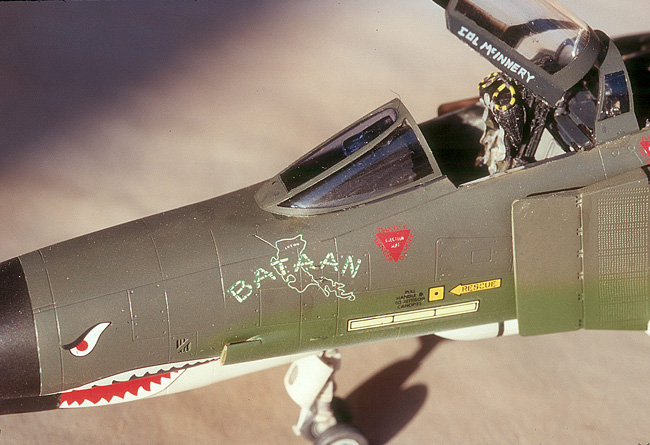
One of the joys of building models for others is that their interests do not always coincide with my own. As I result, I sometimes find myself building kits I hadn’t previously considered building, like the F-4E. The parameters for building the model were Southeast Asian camouflage, white squadron codes, post Vietnam with combat slats, a scheme typical of the late 70’s and earlier 80’s. The kit I was given to build was an original release, the kit decals included appropriate markings, but they were at least eighteen years old and I thought I could do better. Four decal sheets later, I replicated the kit markings for the 3rd Tactical Fighter Wing’s commander’s aircraft out of Clark Airbase in the Philippines, circa 1981.

Construction began with the cockpit, while providing plenty of opportunity for the aftermarket I decided to keep it simple and limited myself to replacing the kits rather anemic looking ejection seats with a pair of Martin-Baker Mk. 7 seats from True Details. The cockpit tub, sidewalls and instrument panel were painted Dark Gull Gray, the instruments dial were painted black and highlighted with Prismacolor pencils. The instrument glass was simulated with drops of Future Floor wax applied with a fine brush. The seats were painted flat black and dry brushed with a medium gray; the details were painted with a variety of Polly Scale acrylics. The True Details seats do not include the ejection handles or face curtains. These were taken from the kit parts, the handles striped in yellow and black with a brush.

The cockpit is attached to the nose wheel bay prior to being glued into the fuselage halves.  Test fit to insure a proper fit and check the alignment of the pilot’s instrument panel with the coaming, it wants to gap. I added weight to the nose and glued all of the cockpit pieces together, while the cockpit was still setting up, I placed it into the fuselage and taped the fuselage halves together to ensure a good fit.

Hasegawa F4-E Cockpit

Hasegawa F4-E Cockpit

Once the cockpit had set, I glued it into one of the fuselage halves and then glued the fuselage halves together. This was set aside to dry and I skipped ahead to the wings. I started by opening the holes for the Sidewinder racks and drop tank mounts. The wing is a three-piece assembly with the outer panels top and bottom are molded to top wing pieces. Unfortunately, this leaves a seam right through the detail for the wing folds.   There is also a seam through the center of the flaps on the underside that requires filling. Thank you Hasegawa!

Returning to the fuselage, I added the two halves of the radome and cannon. Once dry I cleaned up the seams and did some minor filing of the fuselage seam. Before adding the intake pieces, I sprayed the intake area flat white; aircraft gray can also be used for this area. Since the intakes stand out from the fuselage, I masked off the white areas and sprayed the area behind the intakes FS 34019 and 30219 respectively.   These areas would be difficult to paint once the intakes and splitter plates were added. I then attached the intakes. Minor sanding was needed to blend them in, but the fit was very good. The splitter plates were left off until final assembly.

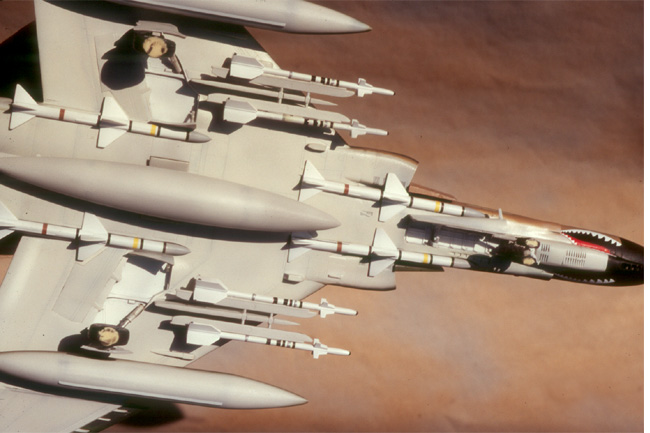
Hasegawa F4-E Underwing Stores

Hasegawa F4-E Underwing Stores

I also added the ECM blister to the vertical fin. This was a mistake as it interfered with the placement of fin cap decal, so I recommend that you leave it for last. The fuel dump pipe is molded to each half of the fuselage. Carefully cut it off and place it somewhere safe.   I didn’t do this and broke it off.   Half of it is still hiding in my carpet; I replaced it with the pipe from a junked Phantom kit I had handy.

I then attached the wings. There was a small gap at the upper wing root that I filled with white glue.   The seam on the underside of wing just aft of the nose wheel bay was terrible; a large seam and step, which runs through the forward Sparrow bay, required a lot of filling. I used putty and super glue to fill this seam and it took several sessions to blend it in. The forward part of the wing assembly extends to the lower side of the fuselage under the intakes. The port side fits flush with the fuselage; the starboard side extends at least a 1/16 of an inch beyond the side of the fuselage. Sanding sticks and super glue to the rescue! Hasegawa provides the option of open or closed speed bakes, I opted for closed and glued them in place.

At this point I began painting, the wheel wells were painted flat white and masked off as were the insides of the gear doors, the landing gear struts, and wheels. I also painted the missiles but more on them later. Once the white had dried, I sprayed the rear fuselage area around the exhausts with Floquil Old Silver. This serves as a base coat for the darker metal colors to sprayed in this area later. Once the silver had dried, I masked it off with Tamiya masking tape. The underside of the Phantom was painted with Gunze Sangyo FS 3662 gray. Prior to spraying the gray, I preshaded the panel lines of the aircraft with Gunze Flat Black. The gray was sprayed over black leaving a shadow that breaks up the monotone of the gray. I also preshaded the upper surfaces before spraying the camouflage. The upper surface was painted in Gunze FS 30419 SEA Tan, Modelmaster FS 34102 Medium Green, and finally Gunze FS 34079 Dark Green. The scheme was sprayed freehand with an Iwata Eclipse. The countershading worked very well for the tan areas, but completely disappeared under the two greens. I restored these areas with Gunze Smoke sprayed along panel lines; I also accented some of the tan areas where I wanted greater contrast.   The nose radome was then masked off and painted with Gunze Flat Black.

Norris Graser was kind enough to show me how to finish the natural metal areas around the exhausts.   These areas are subjected to extreme heating so the metal is typically found in multihued tones ranging from flat aluminum to burnt metal. Norris sprayed various shades of Modelmaster Metalizers along the panel lines, polished them and then sprayed another shade and repeated the process until he got the effect he was looking for. Norris told me he could do this in 5-10 minutes. He worked for over 2 hours until he got the effect he was looking for. It looks great! Thank you Norris.

A note on the kit exhausts, these parts have the exhaust petal detail molded to the outsides of the exhausts, but the insides are absolutely smooth. Aires has just released a set of replacement exhausts for late model Phantoms to replace these overly simplified parts.

After the exhaust area had set for a few days, I sealed it with Future. I then gave the model an overall coat of Future in preparation for decaling. As I stated earlier the kit decals were old enough to vote so I replaced them with Super Scale sheet 48-147. Ironically, this sheet predates the Hasegawa kit and was designed to fit the old Fujimi kit. I had three problems in using this sheet, the first is that the shark mouth decal was designed for the Fujimi kit and is oversized for the Hasegawa kit.   I replaced it with a shark mouth from an Aeromaster Vietnam Phantom sheet. The second problem is that the kit provides four formation strips (slime lights); the Phantom has three strips to a side. This problem was solved by my third problem. I mentioned earlier that I added the ECM blister on the fin cap during the fuselage assembly. This caused all sorts of interesting alignment problems when I tried to put on the fin cap decal, which includes horizontal pin stripes. After ruining the first decal, I stripped it and cut the fin cap decals into smaller pieces and added them individually. I wound up using three sheets to get the fin cap right.   On the bright side I now had lots of extra formation strips. At least one of the Superscale sheets was an original release, but I had no difficulty in using them. Once the decals had set I sealed them with Future.

I then proceeded to adding landing gear and underside stores. Care should be taken in aligning the main gear struts, the struts should be vertical, but the cross braces will pull them inboard if you use them to set the alignment. It would be best to glue the main struts in place and add the cross braces after the main gear has set. The nose gear went on with no problems. The gear doors are fiddly but can be added without too many problems. Good references here answer a lot of questions that the kit instructions don’t cover. I replaced the kit tires with True Details parts. The wheel hub detail is much better than the kit parts.

The Sparrow missiles in the kit suffered from injection pin marks and a nasty mold seam. I replaced them with Sparrows from a junked Hasegawa F-4J (also the source of the lost fuel dump). The Sidewinders were better so I stuck with the kit parts.   After painting and decaling (stripes, many, many stripes) I set them aside. I then turned my attention to the three drop tanks, each is molded in two pieces with the hard point molded to one of the halves. These required sanding and filling especially along the hard point. The tanks were painter in the underside gray with dark green upper surfaces.   Once everything had dried, I glued the Sparrows in place, then the Sidewinder racks and then the Sidewinders.   The drop tanks were left for last.   It would be difficult to mount the Sidewinders after the drop tanks were in place because you probably knock the tanks loose in the attempt.

Now that the Phantom was on its landing gear, I gave it a coat of Polly Scale Flat Finish.   This is a wonderful product with only one drawback. You must filter the Flat Finish through a piece of nylon stocking or you will get little white chunks of flat on you model.

I had originally planned on closing the canopy, but it doesn’t fit in the closed position.   Hasegawa’s recent Phantom releases include a separate closed canopy, so I guess they figured it out. I masked the canopy with E Z masks. Prior to masking I sprayed the windscreen with Gunze Clear Blue. The E Z mask streaked the blue, so I stripped it and resprayed the blue on inside of the windscreen. The fit of the open canopies is fiddly; Mr. Graser was kind enough to assist in getting them into place. I don’t trust myself with super glue and clear parts.

At the very last I attached the nose pitot tube and the fuel dump pipe.

Although nearly twenty years old, the Hasegawa Phantoms are still the best F-4 kits on the block.   Replacement of the exhausts, the tires, weapons, and an resin interior will render a model which can stand up to the best kits being produced today.

Posted in Kit Reviews | Leave a comment

How to write an article for the newsletter or kit review

Writing Outline
by Dick Smith

Writing a story for a magazine, newspaper, or the club newsletter is a lot like telling a friend about an experience. As we relate that experience, we are generally following the rules of good Journalism. There are six basic questions to reporting; Who, What, Where, When, Why and How. Before getting started, we should become familiar with a few terms used in writing.

Lead is the first paragraph of the story and draws the reader into the rest of the copy.  The lead should contain an important fact or statement that tells you why we took the time to write the story.  For example:  “Hasegawa has just released a 1/24 scale model of a Lockheed C-5A Galaxy kit. I just bought one and will have to add an addition to my house to display it.”  Or, if we’re writing about a person, we can say, “Chuck Yeager was the first man to exceed the speed of sound in the Bell X-1.” You can come up with something better than my examples if you give some thought to your article beforehand.

Copy is the term used for the body of the story.  What your are reading now is the “copy of the outline.” Some publishers call copy the “manuscript.”

Slug is the “name” you or the editor gives to identify your story.  If you write a story about a pilot, or a ship captain, his name is usually the slug. The slug and your name go at the top of each page of the story along with a page number.
Source is a book, person or recorded event that is your proof of what you wrote is correct. Usually one source is sufficient in a story but if the event is significant or controversial, two or three sources are recommended. Some editors call this “attribution.”

Style is a way of saying “form” we put our story in for publication.  Most publishers like “plain text.”  That means using a word processor, regular size type, and double-spacing between the lines. This copy is written in 11 point, Times New Roman typeface. The double spacing makes it easier for the editor to make corrections or to change a word or phrase more to his liking or to the “style” of the publication.  Publishers like stories written as a “word document” on a computer.  When you’ve completed the story, put it on a disk to save it, transmit it to the publisher via e-mail or an attachment to e-mail, or print it out and send it to them via “snail mail.”

If you don’t have a computer, type the story on 8½ by 11 sheets of paper, double-spacing between the lines.  Stories in long hand generally are not accepted unless you are famous, published, and on The New York Times  “Top 10 Best Seller List.”

Now lets see how we answer the six questions.

Who:  One of the basic questions we all ask when talking about a new or old kit is, “Whose kit is it?” or “Who made the kit?”  It doesn’t make any difference if it is armor, aircraft, figures, or ships.  Tell us who made the kit and give a little background on the kit.  Is this the first time it has been released?  Was there a model of this particular subject released earlier?  Is there anything special about this release?  A little background on the subject is always important.  Tell us about the “real thing.”  References are important here. If we’re writing a story about an historic person, we must tell the reader who this person is in the lead of the story. Every one connected to aviation knows the name Chuck Yeager , but who was Italo Balbo?  We’ve got to identify him and tell the reader why his is important to our story.  (Blabo was the under secretary for air under Benito Mussolini’s regime. Telling the reader Balbo has a street named after him in Chicago is a nice touch but this does not identify him as being important to your story.)

What:  What kind of a kit is this; plastic, resin, vac-u-form?  Again, if you didn’t answer the “what scale” question earlier; tell us what scale; 1/72, 1/48, 1/32, 1/35.  If you don’t know, tell us “you don’t know.”  There were many kits released by Revell and some other kit manufacturers in the late 50’s and early 60’s that were “box scale.”  That means the scale was dictated by “what ever fit in the standard box.” If we’re writing about a person, we’ve got to answer the questions what did this person do or accomplish so important that we are writing a story about him.  Was he a war ace?  Was he a famous ship captain that performed some heroic duty?  Was he the first to do something important to history?

Where: This may be somewhat important if the kit is old, out of production, rare, or only available from one source. Tell us where the kit was manufactured.  Where did you buy it?  What did you pay for it?  Where can others buy this kit?  For those kits that are very rare this is an important fact, so don’t overlook it. If we’re dealing with a person or thing, tell us where this event happened; time, date, place?  Be specific and document your sources of information.

When:  This segment is one way of weaving a little history into your review.  Tell us about the “real thing.”  When did this ship, aircraft or piece of armor serve?  Or when was the real thing first produced?  When did the first model of this subject appear?  If you don’t know, find out!  If you can’t find out, say so!  Learn to call on fellow modelers and see if they know the answer to a question.  If you need some history about a subject, ask around at the monthly meeting.  (If you want to know something and have a lot of time to listen, ask Norris Graser about P-47’s.) If you have the opportunity, ask the person you are writing about for an interview.  If that’s not possible, look him or her up on the Internet.  Check a book in the library.

Why: This may not seem to be a very important question.  Why did you buy this kit?  Why did you want to build it? Was it on impulse?  Do you have a particular liking for “British jets?”  (I do!)  Why do you like bi-planes?  Answering this question gives the reader somewhat of an insight to your connection with the model.  There is an assumption “the more you know about the real subject, the more accurate your model will be when completed.” Research is very important when doing a story about a person or an object. (Charlie Scardon has a reputation for total accuracy when dealing with ships.  Why?  Because he researches his subjects completely!)  Take notes from books, websites, and your interviews and conversations.  Use the notes when writing your story to back up any statement of fact.  If you say, “Three hundred Spartans held off thousands of Persians at the Battle of Thermopile” back up your statement with a source.

How:  This is probably the easiest of all of the questions to answer.  How did I build the kit?  Tell us all about it.  Did I follow the instructions completely?  How did I find a better way to complete a certain sequence?  How did I correct an inaccuracy?  How did I find the fit? How did I paint it?  How did I determine the markings? I could go on for several more questions, but the important idea here is to tell us, in some detail, “How did I put this particular kit together.” Again, when dealing with a person or event, tell us how this is important.  How did this person change events?  What would you like to know about a person or event that would be of interest to others?  Sometimes the story is a narrative of a little known event.

Summary:  At the end of your article, tell us what are your impressions about this kit or person. Since a kit review or “build” article is not news or historical story, your opinion is important.  Remember to tell the truth.  Back up your opinion with a fact or two.  If you didn’t like the kit, tell us why.  Tell us if the “parts didn’t fit well” or “had to use a lot of filler.”  When you disagree with others about a kit or event, tell us why and back up your opinion with a fact. If it’s a story about a person, sum up this person’s accomplishments.  Tell us why he or she is important and why you think so.  Again, if the summary is controversial, use sources to back up your opinions.

Finally:  When you have completed your story, read it over from beginning to end.  Be critical!  Make sure all of the sentences convey a complete thought or statement.  Take out words or phrases that are confusing.  Check the spelling.  Set the entire story aside and come back to it a day or two later.  You may find a better way of saying something after you’ve had time to think about it.

Posted in Kit Reviews, Newsletter, Tips and Techniques | Leave a comment