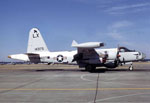
Hasagawa’s 1/72nd scale Neptune for the Hanger One Museum Display

By Dick Smith
Hasagawa’s 1/72nd scale Lockheed P-2V Neptune kit is not one for the inexperienced modeler or one for with little patience. It was released early in the 1970s and has appeared many times as a reissue with only decal changes.
Construction starts with a very sparse cockpit that even lacks control columns. Decals are given for the center console and the instrument panel. There are no specific colors indicated for the cockpit or the navigator/observer’s position in the nose other than “matte gray.” A safe bet would be to spray this area with dark gull gray, FS-36231. The pilot and co-pilot’s seats can be sprayed the same color but a gray darker or lighter would add interest. I added seat cushions painted bright orange, FS-28913, and seat belts made from typing paper dipped in black coffee.
The completed cockpit is glued to the nose gear well and then the whole assembly is cemented to the right side of the fuselage. This model is a “guaranteed tail sitter” so it is necessary to place as much weight as possible under the cockpit floor and in the radome. I used many B-B’s that were sunk in a pool of white glue for this task. Keep in mind that when you think you have enough weight here…you’ll need more.
Since only the very early models of the P-2V carried a top cannon turret this area will have to be closed up using a clear part provided. Be aware that this piece does not fit well and several coats of putty will be required to completely fill in this area. The plastic used in this kit is somewhat soft and the use of super glue filler is not recommended.

There are several clear window parts that you’ll have to decide on using at this point. I opted to leave these off and use Micro Crystal Clear after the painting was complete.
The instructions call for the building of the Wright R-3350-32WA radial engines next. Having been warned about the poor fit and difficulty in construction of this phase, I decided to put this job off until later. Instead, I assembled the horizontal stabilizers and glued them to the fuselage from the inside. This technique eliminates any cement creeping out of the seam and no clean up is required.
The top sections of the wings were then glued to the fuselage in the same manner. When these parts had dried solid, I the bottom parts of the wings into place. This left only filling to be done on the bottom side of the wing joint.
With the wings and stabilizers solidly in place, I glued the fuselage sides together and set the basic construction aside to dry solid. While waiting for the basic airframe to dry solid, I painted the tires Model Master “aircraft interior black,” the landing gear, inside of the gear doors and wheel wells gloss white.
The props are eight individual blades that are very thin and very fragile. The blades are painted black and then the tips are masked and sprayed white. When dry, I carefully masked the white tips in order to paint thin red stripes in the center of the white areas. This is a very time consuming job but the results add to overall appearance of the model.

Since this model was for the Glenview Hanger One museum project, I painted the aircraft in the 70s scheme of flat light gull gray on the lower fuselage, horizontal stabilizers, vertical stabilizer and wings. The top of the fuselage is flat white. I used historical photos of the aircraft to duplicate the paint job. With the fuselage painted and sealed with a coat of Future, I set the model aside to prepare for the decals.
I decided to attach the main landing gear at this point. It is a project that requires several more than two hands to accomplish. Suffice it to say that the job is difficult. I used white glue to attach the parts and when dry beefed up the assembly with super glue.
At this point it was possible to check if the model would stand correctly on its gear. I found that I needed to add additional weight forward. I accomplished this by pouring white clue into hole in the fuselage where the astrodome bubble fits. I then dropped B-Bs into the hole until the aircraft sat on the tricycle gear.
The markings for the aircraft came from various sheets from Super Scale, Micro Scale and Scale Master letters, stripes and numbers. The stylized bird on the top of the vertical stabilizer was made using the historical photo as a pattern and then the shape was cut from Tamiya masking tape to form a stencil.
With all of the markings in place, I sprayed a coat of Testors Dullcoat over the model. When this was dry I attached the clear parts in place with white glue. The small windows were filled with Micro Crystal Clear. The final job was to attach the pre-painted prop blades to the spinner backs and then attach then to the engines.

The model is a difficult build. Many parts do not fit in the manner we are accustomed to with today’s engineering advances. It is a challenge but will build into an impressive replica of the Navy’s early anti-submarine patrol aircraft.