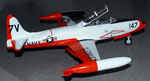
Hobbycraft TV-2 1/48th Scale

By Walt Fink
Back in The Day---before Robert Strange MacNamara came to power in Washington---the Navy, Coast Guard, and Marine Corps had perfectly understandable designators for their airplanes, and the Air Force had theirs as well. Apparently Mr. Mac couldn't understand two systems so in 1962, decided he had a better way and issued Common Service Designators to all aircraft. Thus, the TV-2 became the T-33, the F4D became the F-6, and the F-110 became the F-4.
Bob Reder apparently had some difficulty getting someone
to build the T-33 for the Glenview display and after the umpteenth time he
mentioned this to me, I volunteered to take it on. If I were a quarter-scale
modeler I probably would've done so before.
Finding the kit was the first hurdle. For some reason, at the time it seemed nobody had either the Hawk or Hobbycraft kits...I tried all the usual suspects like Paul Milam and other vendors I know, with no luck. I finally found Clark Farrell had two of the Hobbycraft kits and he was willing to part with one, so I swapped him some other stuff for it.

The kit was the "Korean War T-33" issue and only had the long-range underslung Misawa tanks in it. Since the Navy never flew their T-Birds with anything except the Fletcher tip tanks, I ordered a resin set of those from Gerry Asher at Fox Four Studios..."gmasher@netzero.net".
The kit itself is the core of Hobbycraft's T-33/F-94B Starfire offering and since the two aircraft had different intakes and forward and aft fuselage dimensions and configurations, it looked to me like they managed to somehow put all the different options on the same sprue. Lots of detail was raised above the fuselage skin...which all had to be sanded down smooth

The cockpit tub is pretty basic but has raised console detail which looked nice when I drybrushed and highlighted it. The instructions show the rudder pedals laying flat on the floor---they should hang from the back of the instrument panels so the pedals are vertical. When the cockpit tub's installed in the fuselage, there's a big gap at the front so I made a glare shield from plasticard. The gunsight (for the USAF version) is just a glob of clear plastic so I left it off. The seats are really basic so I added seat cushions made from Aves Apoxie Sculpt, masking tape seat belts and shoulder harnesses, and additional details for the armrests and ejection handles/triggers from wire and styrene strip. When all is painted and installed, it looks OK, if not super-detailed.

The wings have separate tips but with the Fletcher tanks, I didn't need them anyway. There's a blanking plate with some detail which serves as the main wheel wells, and the nose gear well has molded-in detail that's nice.
Separate flaps are meant to be installed in the extended position but there's a big hole in the wing root/fuselage if you decide to do this. I left it alone, figuring nobody looks at the bottom while it's on display.
(Assuming the thing goes into the case sitting on its wheels instead of its
back.) The lower wing didn't fit well to the fuselage and some extensive filling was needed on the left wing root area.
Bob supplied me with a copy of a black-and-white photo taken of a Glenview aircraft, so in a gesture of thumbing my nose at Robert The Strange, I decided to do a TV-2 in those markings. That meant painting the model in the Pre-Day-Glo 1960's Navy Reserve colors of white and International Orange. Naturally, Gunze Sangyo---my acrylic paint of choice---doesn't make an Int'l Orange...only a pure orange...so I mixed my own. Real International Orange actually has a dirty reddish color to it and after some trials and errors, I settled on a mix of four parts orange and one part wood brown. It seemed to come out OK.
I primed the resin tip tanks with Mr. Surfacer, sanded them smooth, and painted them with the same Gunze acrylic I used on the rest of the bird. I used short pieces of .032 brass wire to pin the tanks to the wingtips, and attached them with CA.
Clear parts are OK but a little thick; on the real T-33, there's what looks like an internal brace between the two cockpits---it's really just a support to anchor the forward ends of the wires that support the cloth instrument flying hood. Normally stowed/collapsed over and behind the rear seat, it slides forward on these wires/lines so the poor schlub in the back can get some simulated instrument time. I added the brace from plasticard but omitted the wires. I blanked off the area behind the rear seat headbox with some plasticard and put in the seats. Installed the canopy in the open position using the part supplied in the kit.

Omitted in the instructions, the landing/taxi lights are on a t-shaped part which attaches to the nose gear; I used a pair of MV lenses for the bulbs.
Decals were all from the spares box---individual letters and numbers, mostly. I was going to make the small Bureau Number and designator lettering for the aft fuselage on my computer...but in looking up the correct BuNo, discovered the last three digits on the nose...147...weren't ever a real TV-2 number. All the other station T-Birds I've seen have the last three numbers of the BuNo there, but not this one. Apparently when they were applied, the painters had different instructions. Since my reference photo didn't show the real BuNo, I just left it off.
Not a great kit but it looks like a TV-2 when it's all done. After the fact, I've decided I'm still no 1/48 scale modeler, either.